Mechanical Vapor Recompression / MVR: Energy-Efficient Evaporation for Industrial Wastewater Treatment
Mechanical Vapor Recompression, or MVR, is a key technology for energy-efficient evaporation in industrial wastewater treatment. In MVR evaporation, the water vapor generated during the evaporation process is not discharged as unused waste heat. Instead, it is mechanically compressed and reused as thermal energy within the process.
In industrial wastewater treatment, MVR can help reduce wastewater volumes, recover process water and improve the energy efficiency of evaporator systems. Especially for continuously generated process wastewater, Mechanical Vapor Recompression is an important technology for economical and resource-efficient treatment concepts.
MKR uses MVR in the atmospheric evaporators of the ET series. This creates an efficient energy loop within the system and reliably separates industrial wastewater into distillate and concentrate.
MVR makes evaporation not only technically possible, but also energetically efficient.
What Is Mechanical Vapor Recompression / MVR?
Mechanical Vapor Recompression is a heat recovery process used in evaporation systems. The vapor generated when a liquid evaporates contains thermal energy.
In MVR technology, this vapor is mechanically compressed. Compression increases the pressure and temperature of the vapor. The usable heat is then returned to the evaporation process.
Short Explanation
MVR reuses the vapor generated during evaporation as an energy source. As a result, significantly less external heat is required compared to simple evaporation processes without heat recovery.

Why Is MVR Important for Industrial Wastewater Treatment?
Industrial wastewater is often complex. It may contain oils, emulsions, cleaning chemicals, dissolved substances, salts, metal particles or suspended solids. Direct discharge or reuse is often not possible without suitable treatment.
Evaporator systems thermally separate industrial wastewater into two streams:
- Distillate: recovered water
- Concentrate: concentrated residual stream containing the retained substances
The most energy-intensive part of this process is the evaporation of water. This is exactly where MVR comes in: the energy contained in the water vapor is recovered and reused.
For Operators, This Means:
- lower external energy demand
- improved economic efficiency of evaporation
- reduced disposal volumes
- potential recovery of process water
- stable operation with continuous wastewater streams
- a strong basis for advanced Zero Liquid Discharge concepts

How Does MVR Work in an Evaporator System?
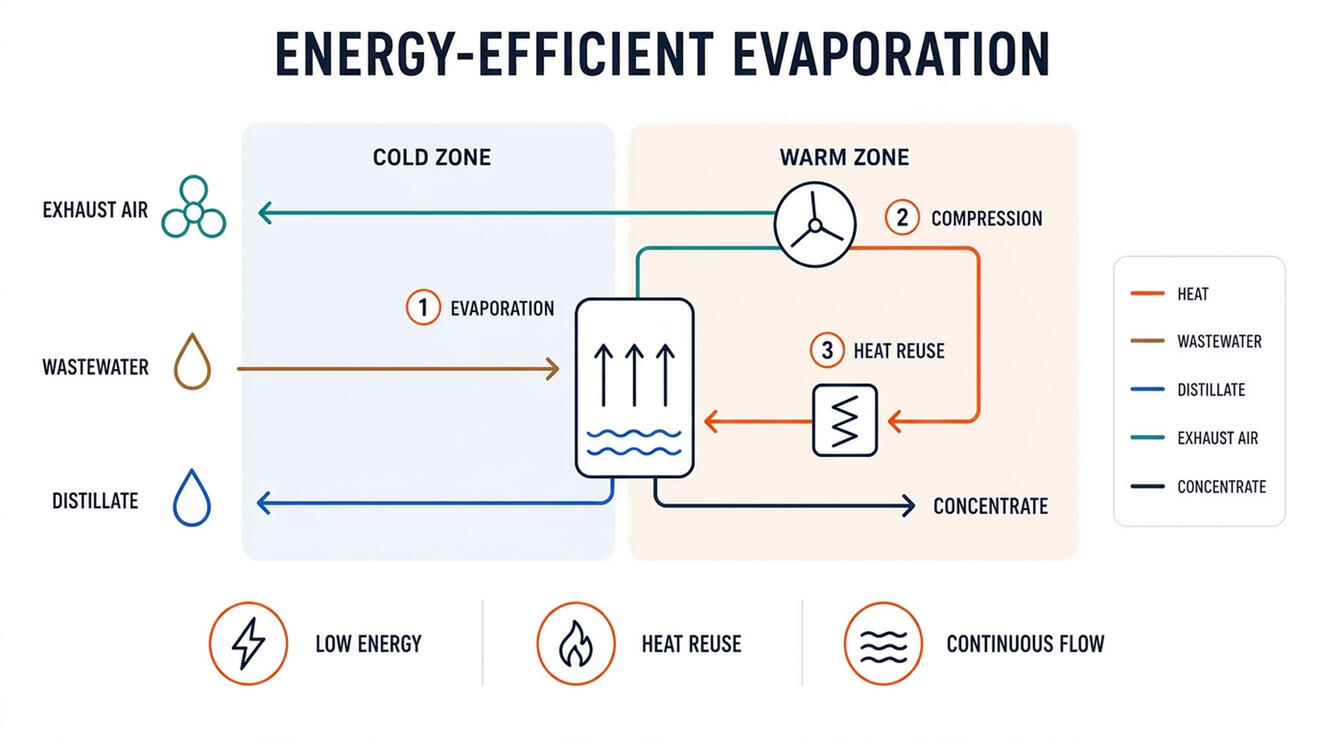
In an MVR evaporator, the process takes place in several steps.
1. Industrial Wastewater Enters the Evaporator
The contaminated wastewater is fed into the evaporator system. Depending on the medium, pretreatment may be required, for example filtration, tramp oil separation or pH adjustment.
2. Water Evaporates
Inside the evaporator, water is evaporated from the wastewater. Non-volatile substances remain in the concentrate.
3. Water Vapor Is Generated
The generated vapor contains usable thermal energy.
4. The Vapor Is Mechanically Compressed
A vapor compressor compresses the vapor. This increases its temperature.
5. The Heat Is Reused
The compressed vapor transfers its heat back into the evaporation process. This creates a closed energy loop within the evaporator system.
6. Distillate and Concentrate Are Discharged Separately
The condensed water is discharged as distillate. The retained substances remain in the concentrate and are discharged in a significantly reduced volume.
What Does MVR Mean?
MVR stands for Mechanical Vapor Recompression.
The term describes the core principle of the technology: water vapor from the evaporation process is mechanically compressed so that its heat can be reused for evaporation.
Important Terms
Term |
Meaning |
|---|---|
| MVR | Mechanical Vapor Recompression |
| Vapor | Water Vapor generated during evaporation |
| Vapor compressor | Compresses the generated vapor |
| Distillate | Recovered water |
| Concentrate | Concentrated residual stream |
| Heat recovery | Reuse of thermal energy contained in the vapor |
MVR in Atmospheric Evaporators from MKR
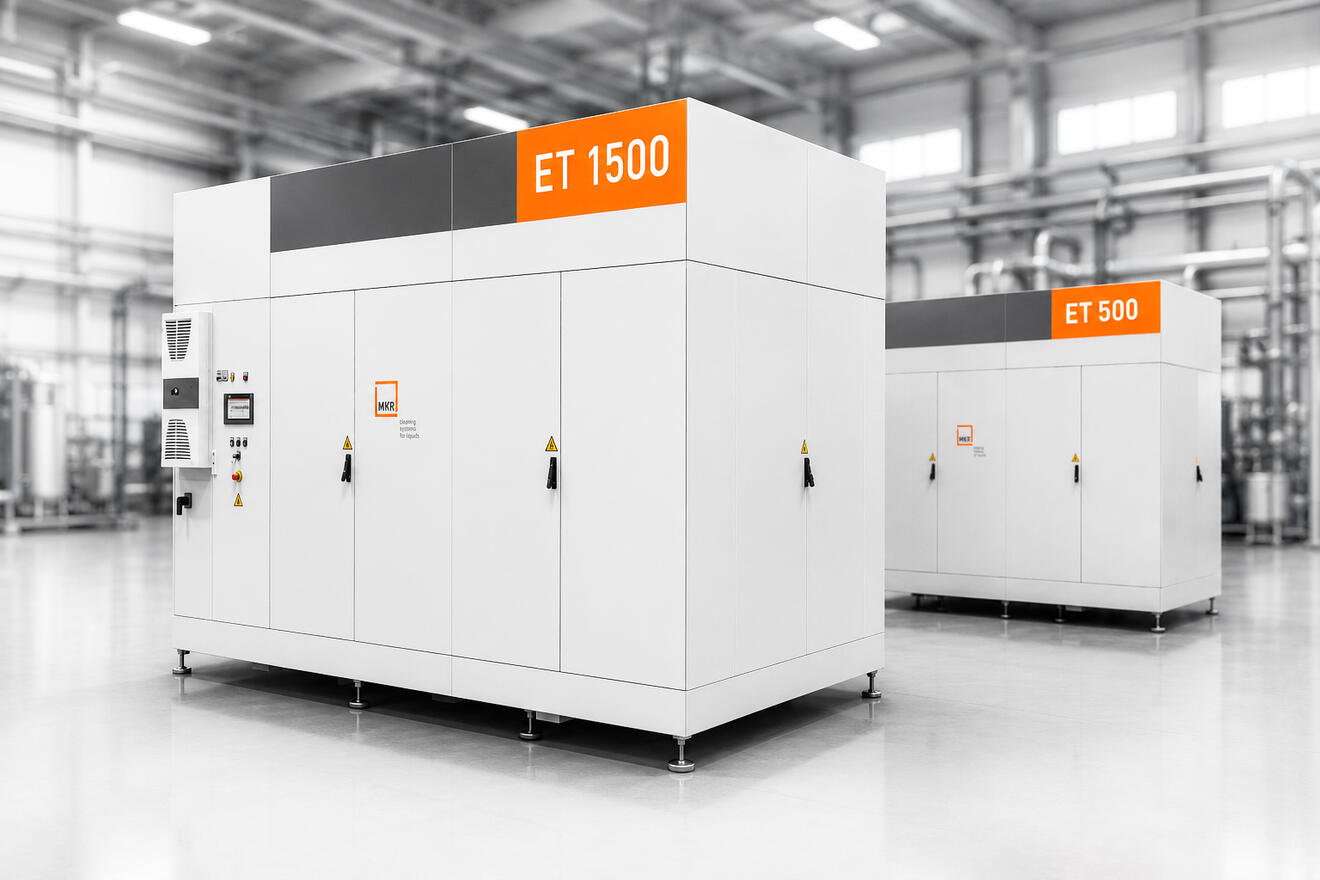
MKR uses MVR in the atmospheric evaporators of the ET series. Unlike vacuum evaporators, these systems do not rely on a vacuum system. Instead, they use atmospheric evaporation combined with Mechanical Vapor Recompression.
The vapor generated during evaporation is mechanically compressed. The recovered heat is reused in the process. This reduces external energy demand and enables efficient treatment of industrial wastewater.
Advantages of the MKR Concept
- atmospheric evaporation without a vacuum system
- Mechanical Vapor Recompression for heat recovery
- robust technology for industrial applications
- fully automatic operation
- separation of wastewater into distillate and concentrate
- modular integration into existing processes
- combination with peripherals, ultrafiltration and ZLD concepts possible
What Are the Advantages of MVR for Industrial Wastewater?
MVR is particularly relevant when wastewater streams are generated continuously and disposal costs need to be reduced.
Energy Efficiency
By returning the heat contained in the vapor to the process, less external energy is required. The evaporator system uses part of the process energy multiple times.
Wastewater Reduction
Evaporation separates water from the contained substances. This significantly reduces the residual volume that needs to be disposed of.
Process Water Recovery
The generated distillate can be reused, post-treated or discharged according to local requirements, depending on its quality and the application.
Economic Efficiency
MVR can improve the economic efficiency of an evaporator system, especially when disposal costs are high, wastewater volumes are large or operation is continuous.
Process Reliability
Automated evaporation and controlled process management allow industrial wastewater streams to be treated reliably.
ZLD Capability
MVR evaporation can be a central component of Zero Liquid Discharge concepts when liquid residual streams need to be strongly reduced.
Which Wastewater Streams Are Suitable for MVR Evaporation?
MVR evaporation is suitable for many industrial wastewater streams where water needs to be separated from dissolved, suspended or non-volatile substances.
Typical applications include:
- wastewater from parts cleaning and degreasing
- wastewater containing cooling lubricants
- washing and rinsing water
- wastewater from surface treatment
- electroplating wastewater
- wastewater from paint pretreatment
- process water from chemical applications
- oily industrial wastewater
- concentrates from pretreatment processes
- wastewater from recycling and disposal processes
The technical suitability always depends on the medium, composition, flow rate, target quality and desired treatment result.
When Is MVR Particularly Useful?
MVR evaporation is particularly useful when several of the following factors apply:
- high disposal costs
- relevant or continuous wastewater volumes
- complex wastewater composition
- requirement for process water recovery
- increasing demands for resource efficiency
- limited discharge options
- target of strong volume reduction
- need for automated wastewater treatment
- integration into a Zero Liquid Discharge concept
MVR is especially suitable for continuously generated industrial wastewater, high disposal costs and the goal of recovering water or significantly reducing liquid residual streams.
MVR, Evaporation Technology and Zero Liquid Discharge
MVR is not a stand-alone wastewater solution. It is a technology within evaporation systems that makes the evaporation process more energy-efficient.
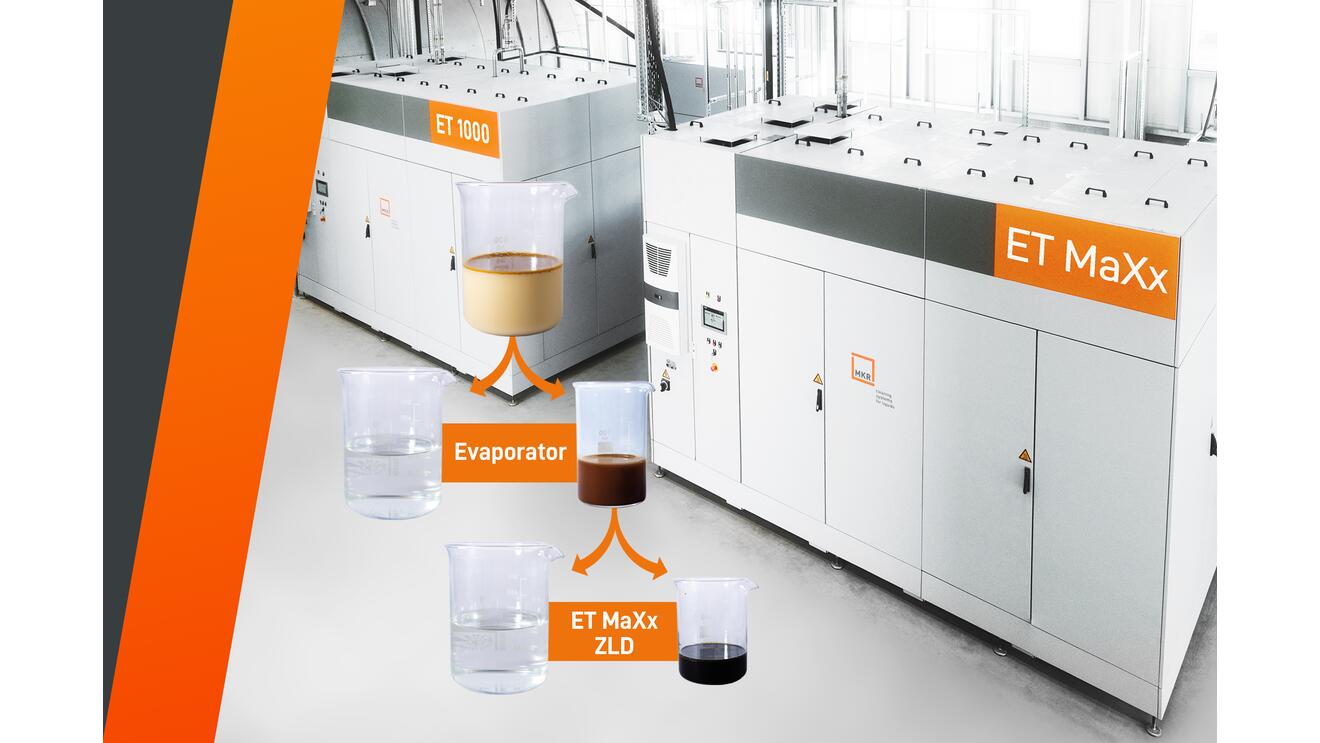
In a complete treatment concept, MVR can be combined with additional process steps:
- pretreatment to remove oils, particles or interfering substances
- MVR evaporation to separate wastewater into distillate and concentrate
- post-treatment of the distillate for defined target qualities
- further concentrate reduction with ET MaXx ZLD
- return of process water
- controlled discharge of residual substances
MVR as a Component of a ZLD Concept
Zero Liquid Discharge means reducing liquid residual streams as far as technically and economically feasible. MVR evaporation can play a central role in this process because it recovers water from wastewater and collects the remaining substances in the concentrate.
However, the specific implementation of a ZLD concept always depends on the medium, target quality, salt content, residual substance behavior and economic conditions.
Your Advantages with MVR Evaporation Technology from MKR
- energy-efficient evaporation through Mechanical Vapor Recompression
- significant reduction of liquid residual streams depending on the application
- separation of industrial wastewater into distillate and concentrate
- potential recovery of process water
- robust atmospheric evaporation technology without a vacuum system
- fully automatic operation
- integration into existing processes
- combination with peripherals, ultrafiltration and ZLD possible
- technical design matched to medium and target quality
- support for resource efficiency and circular water management