Industrial Laundry Wastewater Recycling: Recovering Water Instead of Disposing of It
Case study from the Baltic region: How ceramic microfiltration and MVR evaporation help recover water from highly contaminated industrial laundry wastewater.
Industrial laundries process large volumes of water every day. Washing heavily soiled workwear, industrial wiping cloths and entrance mats generates complex wastewater streams containing oils, detergents, fibres and suspended solids.
Rising water and energy costs, increasing environmental requirements and the need for reliable wastewater treatment are driving demand for more efficient water recycling solutions.
A project in the Baltic region demonstrates how different wastewater streams can be treated separately and valuable process water recovered for reuse.
In cooperation with Belmar Technologies from the United Kingdom, MKR Metzger developed a multi-stage wastewater recycling concept tailored to the requirements of an international textile service provider.
The Challenge: Highly Contaminated Industrial Laundry Wastewater
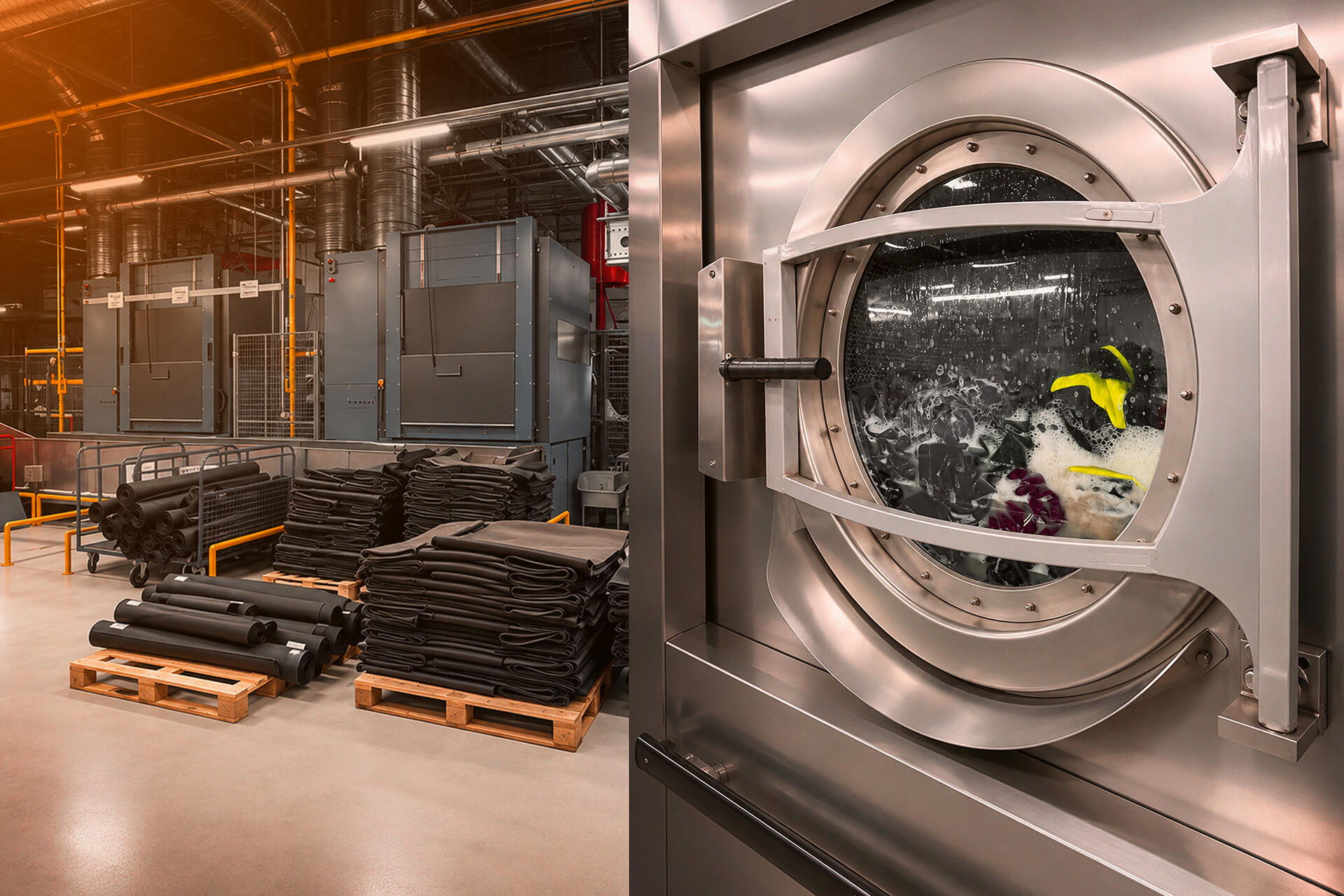
The textile service provider processes industrial wiping cloths, workwear and entrance mats contaminated with substances including oils, metalworking fluids, brake fluids and testing media.
The washing process generates alkaline wastewater containing emulsified oils, surfactants, fibres and suspended solids.
The existing dissolved air flotation (DAF) treatment system required considerable operating resources and was no longer able to consistently meet increasingly demanding wastewater quality requirements.
The company therefore needed a more efficient treatment concept capable of reducing chemical consumption, recovering water and reliably processing wastewater streams with varying contamination levels.
The Solution: Multi-Stage Wastewater Treatment Using Ceramic Microfiltration
MKR and Belmar Technologies developed a tailored treatment process combining several technologies:
- Vibrating screens for removing fibres and larger solids
- Self-cleaning pressure filtration for further pre-treatment
- Ceramic crossflow microfiltration for separating fine contaminants
- Energy-efficient MVR evaporation for additional water recovery
The treatment concept processes different wastewater streams according to their composition and the quality required for reuse.
Recycling Highly Contaminated Washing Liquor
A ceramic membrane filtration system with a total filtration area of 16 m² was installed to treat wastewater from industrial wiping cloth cleaning.
According to the published case report, the system was designed for fluctuating contamination levels and treatment capacities of up to 30 m³ per day.
Pre-treatment and ceramic microfiltration remove fibres and suspended solids, separate emulsified oil fractions and reduce surfactant concentrations.
The treated hot washing liquor can subsequently be reused in the washing process.
This reduces the need for fresh water and additional washing chemicals while retaining useful thermal energy within the process.
Energy-Efficient Rinse Water Recovery Through MVR Evaporation
The subsequent rinsing stages generate a separate wastewater stream with lower concentrations of washing chemicals.
After removing fibres and suspended particles, the rinse water is treated using evaporation technology with Mechanical Vapor Recompression (MVR).
In an MVR system, the water vapour generated during evaporation is compressed, increasing its pressure and temperature. The recovered thermal energy is then reused in the evaporation process, reducing the demand for additional heat.
For the application described in the published report, the MVR evaporation process required approximately 40 kWh per cubic metre of wastewater treated.
The system enabled the recovery of approximately 1.5 m³ of rinse water per hour, which could then be returned to the industrial wiping cloth cleaning process.
The Results: Reduced Freshwater and Chemical Consumption
The project demonstrates the potential of application-specific wastewater treatment and water reuse.
For the washing liquor recycling process, the published case report provides the following results:
| Parameter | Project-Specific Result |
|---|---|
| Freshwater demand | Reduced by up to 98% |
| Sodium hydroxide consumption | Reduced by up to 80% |
| Chemical consumption | Approximately 800 litres saved per day |
| Additional steam heating for the washing machines | No longer required |
Reusing the treated hot washing liquor also helps retain thermal energy within the cleaning process.
These figures describe the specific applications and operating conditions reported in the project. They are not general performance guarantees for other industrial laundries.
Additional Application: Entrance Mat and Rental Textile Washing
The project also included wastewater treatment for entrance mat and rental textile processing.
A ceramic microfiltration system with a total membrane area of 64 m² was used, with treatment capacities of approximately 120 to 150 m³ per day.
According to the report, the wastewater could be concentrated by a factor of more than 70.
The following treatment results were reported for this wastewater stream:
-
More than 99% microplastic removal
-
Approximately 96% chemical oxygen demand (COD) reduction
-
Approximately 95% fats, oils and grease (FOG) removal
-
Approximately 99% total suspended solids (TSS) removal
-
Approximately 97% surfactant reduction
These results illustrate the potential of ceramic microfiltration for treating complex industrial laundry wastewater.
An Integrated Approach to Industrial Laundry Water Recycling
A key feature of the project is the separate treatment of different wastewater streams.
Ceramic microfiltration supports the cleaning and reuse of contaminated washing liquor, while MVR evaporation enables further recovery of rinse water.
Combining these technologies can reduce freshwater consumption, chemical demand and wastewater disposal volumes while improving overall resource efficiency.
Such multi-stage treatment systems can also provide a foundation for advanced closed-loop water recycling and Zero Liquid Discharge (ZLD) concepts.
Conclusion: Turning Wastewater into a Valuable Resource
Industrial laundry wastewater is highly variable in composition. Efficient treatment therefore requires careful consideration of wastewater characteristics, process requirements and the desired quality of recovered water.
The Baltic case study demonstrates how mechanical pre-treatment, ceramic crossflow microfiltration and MVR evaporation can work together to recover process water and reduce resource consumption.
MKR Metzger develops tailored industrial wastewater treatment and water recycling solutions based on the specific requirements of each application.
Explore Water Recycling Opportunities for Your Laundry
Are you looking to reduce freshwater consumption, recover washing or rinse water and optimise wastewater treatment costs?
Discuss your wastewater streams and process requirements with MKR to identify suitable treatment technologies.
Source: “Wasser neu denken statt entsorgen”, R+W Textilservice, issue 7–8/2026, pages 58–60. Editorially adapted for the MKR website.